Investigation: Do EMF 'Protection' Products Actually Work, or Is It Another Wellness Scam?

We tested phone cases, stickers, chips, Faraday cages, and shielding fabric. Four categories. Twelve products. Six months. Only one is still working.
Margaret Ellis, RN, DNP has spent twenty-eight years in clinical practice with a focus on integrative health and environmental wellness. As the Former Director of Integrative Health at Cleveland Clinic, she has evaluated hundreds of wellness products and alternative treatments throughout her career.
Her investigative work focuses on separating evidence-based treatments from marketing hype, helping people make informed health decisions based on scientific testing rather than trends.
In almost three decades of medical practice, I've learned one thing about wellness products: most of them are selling you a feeling, not a result.
I've watched magnetic bracelets come and go. I've watched copper-infused socks promise circulation miracles. I've watched "detox" patches that turned black overnight and called it proof they were pulling toxins from your body. They weren't. It was sweat reacting with vinegar.
So when I started hearing about EMF protection products — stickers, phone cases, little chips you slap on your devices — I didn't even bother looking into them.
My position was simple: if you're worried about your phone, put it down.
That position held until early last year.
- We tested four categories of EMF protection: phone cases, chips/stickers, Faraday cages, and shielding fabric
- Only one product survived the full testing
- Most products are either physically incapable of doing what they claim or actively made things worse
- Real-world testing showed significant sleep improvements and brain performance

My twin grandchildren — Liam and Sophie, both nine — started complaining around March last year.
It started small. Liam would come home from school and say his head felt "buzzy." We thought he was just tired.
Sophie started taking over an hour to fall asleep at night — she'd always been out in ten minutes. Their mom thought it was growing pains or maybe too much sugar.
Then it got worse.
Liam stopped wanting to play outside after school. He used to drop his backpack at the door and be in the backyard before I could ask him about his day. Now he'd come home, say his head hurt, and lie on the couch. His mom said he'd been asking to skip soccer practice — the kid who used to beg to go early.
Sophie stopped reading before bed. She'd always been the kid with the flashlight under the covers at 9:30 — couldn't put a book down. Now she'd just lie there staring at the ceiling, saying she felt "weird and tired." She stopped wanting to have sleepovers with her best friend. When I asked why, she said she just didn't feel like it.
These were kids who couldn't sit still six months ago. Now they were turning down the things they loved.
Their parents took them to the pediatrician. Everything checked out. No vision problems. No allergies. No deficiencies. The doctor said it was probably just adjusting to more screen time — the school had switched to digital textbooks that spring.
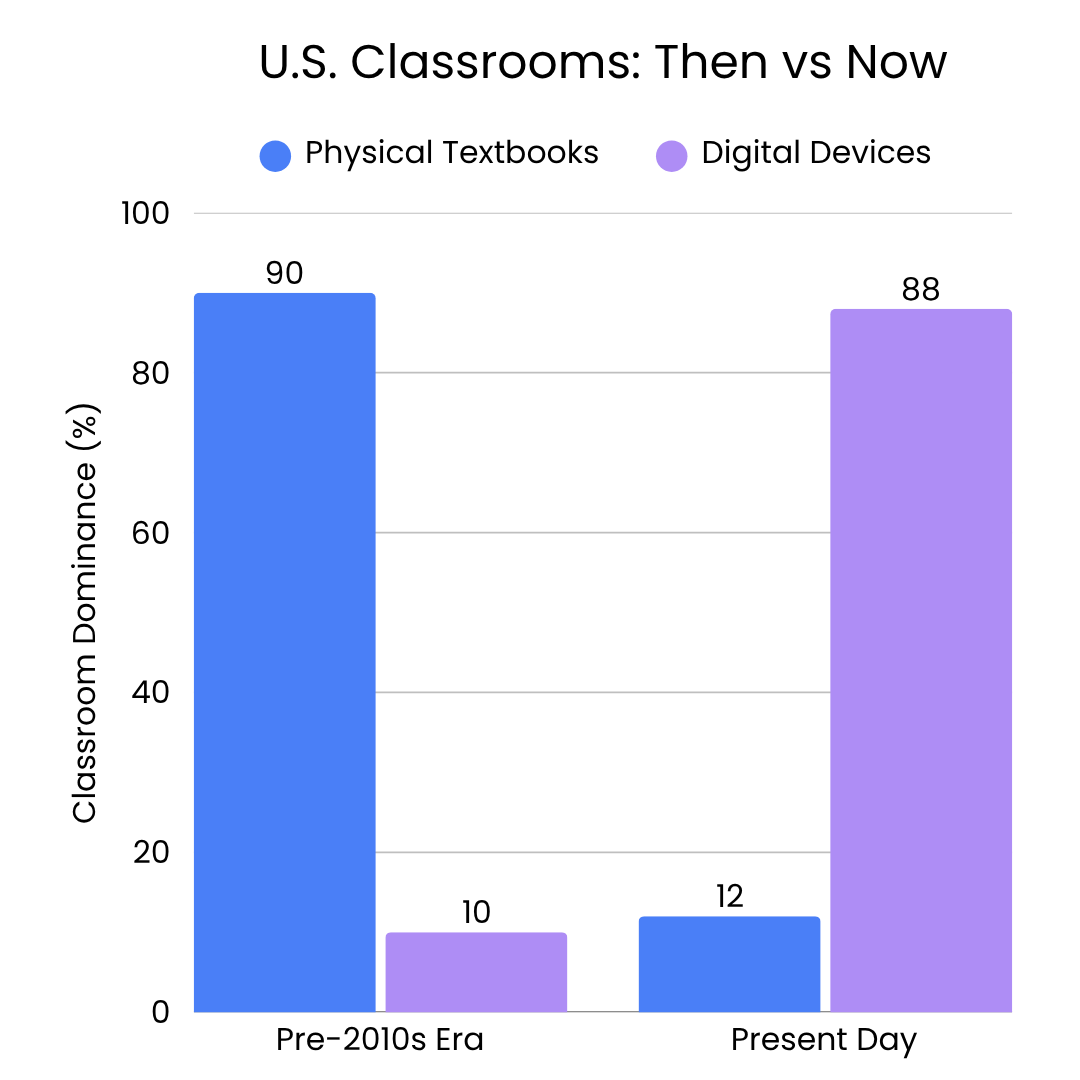
I might have left it there. Kids complain.
But then Summer break happened.
Off school. No iPads. No school laptops. Limited screen time — maybe an hour of TV a day.
By day four, Liam's headaches were gone. He was outside before breakfast, came back muddy, asked if he could go to soccer practice a day early. His mom almost cried.
Sophie read an entire book in two days. She asked her best friend to sleep over that Friday. She was falling asleep in fifteen minutes again — sometimes with the flashlight still on and the book open on her chest.
I hadn't realized how much of them I'd been missing until they came back.
When school started up in September and the devices came back, so did everything else. Within a week. The headaches. The sleep problems. The tired eyes. The kid on the couch who used to be the kid in the backyard.
That's when I stopped dismissing it. These weren't growing pains. Something was happening to my grandchildren, and it was tied to the devices they were using six hours a day.
I did what I always do when something gets past my skepticism — I went to the research.
What I found surprised me.
- A study from Environmental Health — published by Springer — found that reducing EMF exposure during sleep increased melatonin and serotonin levels and reduced markers of biological aging within two months.
- A study in Bioelectromagnetics found that when a radio transmitter near a residential area was shut down, melatonin levels in nearby residents rose by 15% and sleep quality improved measurably.
- A study in PLOS One — occupational medicine — showed that workers who reduced their daily EMF exposure had measurably better sleep quality and duration.
- A double-blind, placebo-controlled trial in Frontiers in Public Health found that removing a 2.45 GHz device from the bedroom significantly improved sleep scores.
- And a paper in the Journal of Environmental Medicine documented fatigue, headaches, concentration problems, and skin irritation from chronic close-range device exposure.
Twenty-three peer-reviewed studies across legitimate journals. Not fringe science. Not conspiracy theory websites. Real research from real institutions.
Then I went to the forums.
Reddit. Facebook groups. Parenting communities. EMF sensitivity threads. I spent three weeks reading through hundreds of posts from real people.
The patterns were everywhere.
- People describing tingling in their hands after holding their phone for long calls.
- Rashes on the thigh where they kept their phone in their pocket.
- Headaches that showed up at work and disappeared on weekends.
- Sleep that fell apart when they moved into an apartment with a cell tower on the roof.
- Brain fog that lifted on camping trips.
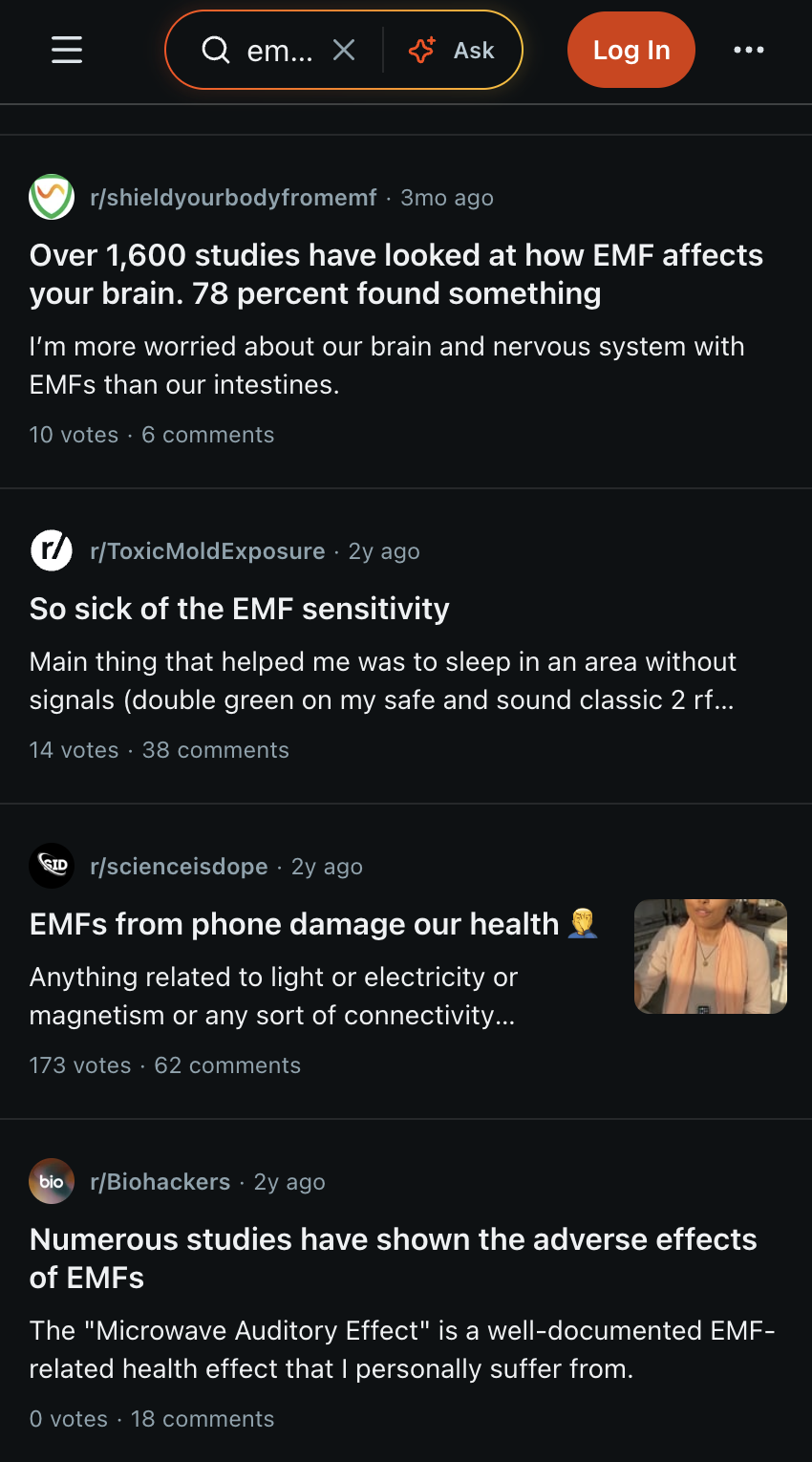
Some of these people were clearly anxious and spiraling. But many of them were calm, specific, and frustrated that nobody believed them. Engineers. Teachers. Nurses. Normal people who'd noticed a pattern and couldn't explain it.
One post from an electrician stayed with me:
Now — I want to be clear about something.
My grandchildren are sensitive. The people getting rashes and tingling hands are sensitive. The electrician with the weekend headaches is sensitive. These are people whose bodies react strongly enough that they can feel it and point to it and say "this is the thing."
But that doesn't mean the rest of us are fine.
That's like saying the person who coughs in a smoky room is the only one breathing the smoke. They're not. They're just the first one whose body says something out loud.
And the studies were the same — disrupted sleep, lower melatonin, increased fatigue, reduced concentration.
Just quieter. Slower. The kind of thing you don't connect to your phone because it builds so gradually you think it's just aging, or stress, or not sleeping well "lately."
So I started asking a different question. Not "how do I protect my sensitive grandchildren?" but "how do I protect everyone in my household from something most of us don't even realize is affecting us?"
And that's when I started looking at what's actually available.

I bought twelve products across four categories ($39–$279):
And recruited 12 volunteers with headaches, poor sleep, fatigue, or brain fog they associated with device use — ages 27–71.
- Electromagnetic wave patterns (with my spectrum analyzer — weekly readings)
- Self-reported symptom logs (headaches, fatigue, sleep quality — daily)
- Sleep scores from wearable devices
- Focus and concentration (weekly assessments)
Six months. Same conditions. Same equipment. Let the data talk.
I'll be honest — the first week surprised me.
Most of the products showed something on the spectrum analyzer.
By day seven, I was starting to think I'd been wrong about the whole category.
I wasn't wrong. I was early.
All three phone cases showed reduced readings on the shielded side — the side facing the case lining. But on the other side — the side facing your face during a call — the readings were higher than the bare phone.
Not slightly higher. 45-70% higher.
I pulled all three from the test immediately. I wasn't going to let my volunteers use something that was making their exposure worse.
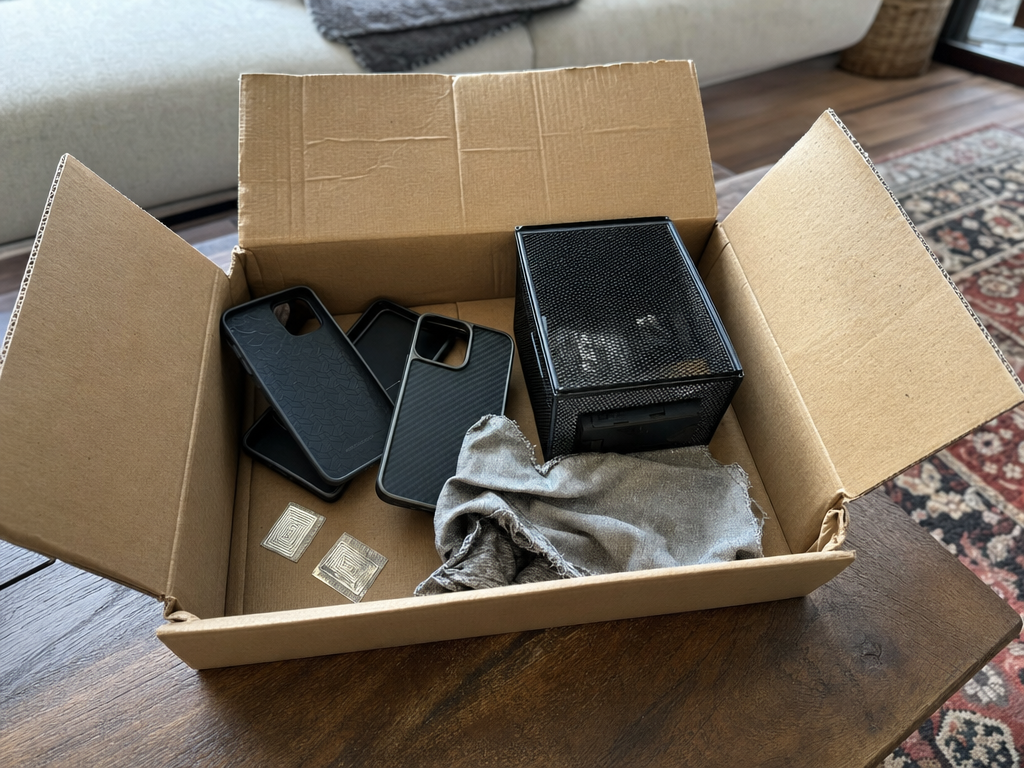
Around week eight, volunteers started reaching out. "My headaches are coming back." "I'm not sleeping as well anymore." "Maybe my body adjusted?"
Their bodies didn't adjust. The products degraded.
I tested everyone's devices. Here's what I found:
- Aulterra Neutralizer & EMF Harmony Harmonizer+ — Dead. Back to baseline. Looked identical on the outside.
- Aires Shield Pro — Faint reading. Hanging on but not doing much.
- ODIN SafeWave — Clean, consistent readings. Same as week one.
- Mission Darkness Faraday Box & SignalVault Router Cage — Blocked the signal from the router completely. Also blocked the WiFi completely. No internet in the house.
Technically a success. Practically useless. - SYB Router Guard — Minimal effect on readings. Not enough shielding to change anything meaningful.
- SYB Bed Canopy Fabric — Showed a small reduction in week one, but only when draped directly over the device with no gaps. By month two, back to baseline. The metallic coating had oxidized.
- EMF Protection Blanket (Amazon) — Never showed any measurable change. Not even in week one. Whatever was in it wasn't doing anything from the start.
By month three, ten out of twelve products were completely dead on my spectrum analyzer.
- Three phone cases — pulled at week two for increasing exposure
- Three Faraday cages — either blocked the WiFi or did nothing
- Two fabric products — degraded or never worked
- Two chips/stickers — increased exposure and degraded
Only two chips left.
After four months, only two were still showing any measurable pattern change:
- ODIN SafeWave — Clean, consistent readings. Volunteers using it still reporting symptom improvement.
- Aires Shield Pro — Faint. Barely registering. No consistent symptom improvement.
- ODIN SafeWave — Still producing clean, organized wave patterns. As effective as day one.
- Aires Shield Pro — Dead. Flat. Nothing.
Twelve products. Four categories. Six months.
One single product was working effectively as the day I stuck it on.
How was this possible? I needed to know.
ODIN SafeWave was a company I'd never heard of.
Small operation out of Huntsville, Alabama.
Their website looked like a side project.
No fancy branding. No influencer partnerships. No social media presence.
Yet their chip outlasted products costing twice as much from companies with real marketing budgets.
I found the contact on their website and offered a call.
Next morning, my phone rang.

Raymond Connors wasn't what I expected.
A 72-year-old retired electromagnetic systems engineer from Lockheed Martin — the defense contractor that builds radar systems, satellite platforms, and electronic warfare systems for the United States military for 31 (!) years.
He stumbled into EMF protection through his wife's headaches after retirement.
"That's exactly what I found," I said.
"Right. So I did what engineers do — I figured out why they all fail, and then I solved the problem."
"There are really only three ways these products fail," Raymond explained.
"The first is degradation.
Most stickers and chips use metallic compounds — gold foil, copper coatings, crystal mixtures. They look great out of the package. But your phone generates heat. Your pocket generates moisture. Within weeks, the active material oxidizes. The product looks identical. The material doing the work is gone."
"The second is the shielding backfire.
Phone cases, Faraday cages, anything that uses metal to physically block the signal — your phone detects that as interference.
Think of someone trying to talk to you through a thick wall. They don't go quiet — they shout louder. The phone cranks up its output power to punch through. You end up with more exposure, not less. That's what happened with your phone cases."
"The third is that it just never worked in the first place.
Shielding fabrics, most of those Amazon products — there's not enough active material to change anything. They're selling you a concept. Not a product."
"You know noise-canceling headphones?" Raymond said. "They don't block sound. They reshape it so it stops overwhelming your ears. Same noise in the room. Completely different experience for you."
"That's what this chip does. It doesn't block your phone's signal — it harmonizes it. Your calls, texts, WiFi, Bluetooth — everything works exactly the same. The only thing that changes is how the wave is shaped. Instead of chaotic and scattered, it becomes clean and organized."
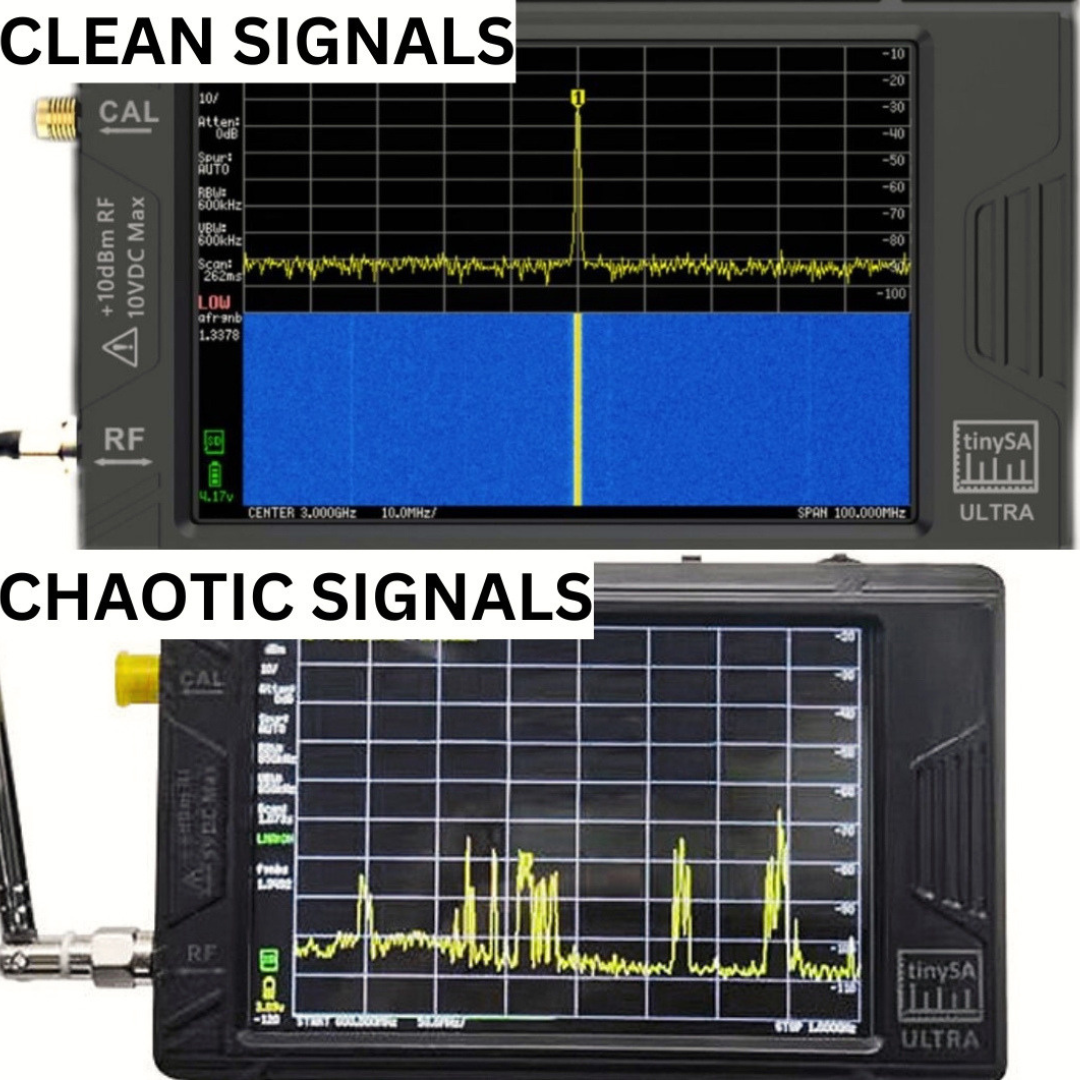
"This is what I did for thirty-one years at Lockheed. A fighter pilot sits in a cockpit flooded with electromagnetic energy for hours — he can't afford a headache at Mach 2. So we don't block the signals he needs. We harmonize them. Reshape them so they stop overwhelming everything inside the cockpit."
"Same principle is in every commercial plane you've flown on. Electric vehicles. Hospital imaging rooms. Engineers have been solving this problem for decades — just nobody thought to shrink it down and put it on a phone."
"How?" I asked.
"A fractal pattern etched into silicon. Non-metallic — so your phone doesn't even know it's there. No resistance means no power boost. The signal passes through the geometry and comes out the other side organized instead of chaotic. That's it. Not blocking. Harmonizing."

He held up his personal phone. "First prototype. Three years on this phone. Every single day."
He showed me the readings. Clean. Structured. Organized. After three years of daily use.
My $89 chip degraded after 2 months.

"This wasn't cheap to develop," I said.
He laughed. "Frank and I pooled our retirement savings and brought in two other Lockheed colleagues. About $406,000 total."
"How did your wife take that?"
"She almost left me. Then her headaches stopped after using the prototype, so she forgave me. But here's the thing — I showed our technology to three major manufacturers. You know what they told me?"
"What?"
"Why would we want a product that actually works when customers keep reordering every few months?" They told me their business model depends on products failing. Repeat customers. Planned obsolescence — for a wellness product.
Two weeks after our call, Raymond sent an email that surprised me.

I called him immediately.
"Raymond, you can't be serious about selling at cost."
"Margaret, these companies are stealing from people. If your article helps people find something that actually works AND saves them money? Also, word spreads. That's not charity. That's smart marketing — just the honest version."
I reached out to ODIN SafeWave customers to verify results beyond my test group:
This is the part that matters most to me — personally and professionally.
Children are more sensitive to electromagnetic field exposure because their bodies and brains are still developing. Their skulls are thinner. Their nervous systems are less mature. They absorb energy differently than adults.
A colleague — a neurologist — put it to me plainly:
- The American Academy of Pediatrics has specifically called for updated guidelines on children's electromagnetic field exposure.
- The World Health Organization has recommended further research.
Liam and Sophie have ODIN chips on every device they use now. Their school iPads. Their home tablets. The family laptop.
Liam hasn't complained about a "buzzy head" since March. Sophie falls asleep in under twenty minutes most nights.
I'm not saying the chip is the only reason. We also moved the router, changed charging habits, set up better screen time boundaries.
But the chip is the one thing protecting them during the hours I can't control — at school, at their friends' houses, everywhere else.
"Will it mess with my phone?"
This was everyone's first concern, including mine. Here's what I can tell you after six months:
The SafeWave chip does NOT reduce your phone's signal. Not by 1%. Calls, texts, WiFi, Bluetooth, battery life — completely unaffected.
Across fourteen volunteers over six months:
- Zero signal interference
- Zero dropped calls
- Zero battery drain
- Zero device issues
The phone works exactly the same. The wave pattern is the only thing that changes.
After six months of testing twelve products across four categories, here's what I found:
- Phone cases with metallic shielding made things worse. They partially blocked the signal and forced the phone to increase its output. More exposure, not less.
- Faraday cages either killed the WiFi entirely or didn't do enough to measure.
- Shielding fabric degraded within weeks or never worked in the first place.
- Most chips and stickers worked briefly then died as their materials broke down from heat and moisture.
- The industry profits from failure. Repeat customers every few months is their business model.
- One single product — out of twelve — was still reorganizing electromagnetic wave patterns as effectively at month six as it was on day one.
The technology exists to "reorganize" and "harmonize" chaotic EMF into clean, coherent patterns instead of "blocking" it. But only one company is using it.
At 58, with almost three decades of clinical experience, I've learned to be very selective about what I put my name behind.
I now own nine ODIN SafeWave chips. One on my phone. One on my tablet. One on my laptop. One on the family router. And one on each of my grandchildren's devices.
Not because Raymond gave them to me. I insisted on paying full price. But because after six months of testing everything I could find, they're the only product that actually worked.
My sleep is consistent. My afternoon focus stays sharp. The low-grade headaches I'd gotten so used to that I stopped noticing them — they're gone.
And Liam and Sophie are sleeping through the night again.
All from a chip that does exactly what it claims — week after week, month after month — with no sign of stopping.
Raymond set up a separate page exclusively for readers of this investigation:
The offer is valid for 72 hours after publication. Current inventory is approximately 583 microchips before the next production run in 3-4 weeks.
Every order includes a 30-day money-back guarantee. Raymond wants you to test it yourself.
When I asked Raymond why he's still doing this at 72, his answer stayed with me: